👷 Safety First
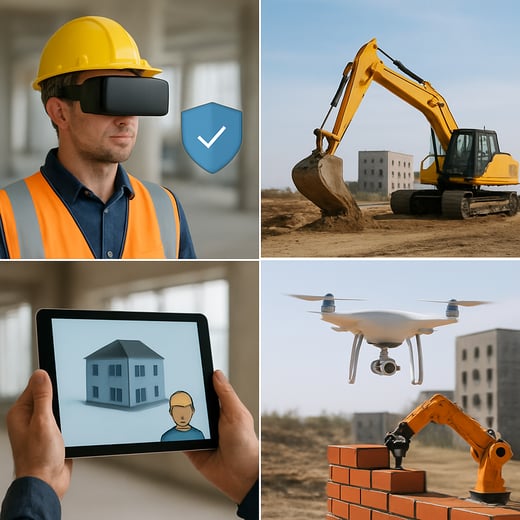
Tech isn’t just about working faster, it’s about working safer. Wearables embedded in hard hats and vests monitor posture, fatigue, and even vital signs to help prevent accidents. VR training allows crews to practice in simulated environments, while AR overlays can guide workers through checklists on site. Add in site sensors that track air quality, noise, and temperature, and jobsites are becoming smarter—and safer—than ever.
🚜 Offsite & Autonomous
Think of construction as an assembly line: modular rooms and prefabricated panels are now built in controlled environments, then shipped and installed on-site. Meanwhile, autonomous heavy equipment is handling excavation and grading with GPS accuracy. Together, these approaches cut down on waste, speed up timelines, and help offset skilled labor shortages.
📱 Software & Collaboration
Gone are the days of chasing down paper RFIs or waiting on outdated reports. Cloud-based software and mobile apps are powering real-time collaboration, connecting project managers, field teams, and office staff instantly. With Building Information Modeling (BIM), teams can simulate schedules, visualize project phases, and overlay designs on actual builds, keeping everyone aligned and projects moving.
🤖 AI, Drones & Robots
Artificial intelligence is turning jobsite data into predictive insights, from spotting safety risks to flagging costly errors before they spiral. Drones and rovers scan sites daily, feeding AI systems that compare progress against BIM models. Robots are lending a hand too—tying rebar, laying bricks, and handling repetitive tasks so humans can focus on the complex work.
📉 The Productivity Push
Construction productivity has lagged for decades, but tech is closing the gap. Automated data entry, smarter scheduling, and integrated tools mean fewer silos and more streamlined workflows. Firms that embrace these solutions are building faster, smarter, and with fewer surprises.
The Bottom Line
Construction firms that lean into technology aren’t just keeping pace—they’re pulling ahead. From safety wearables to autonomous machines, the industry is in the middle of a digital transformation that’s rewriting how buildings get built.
Those who adopt now will stay competitive. Those who don’t? Risk getting left behind.